
Investor Letter


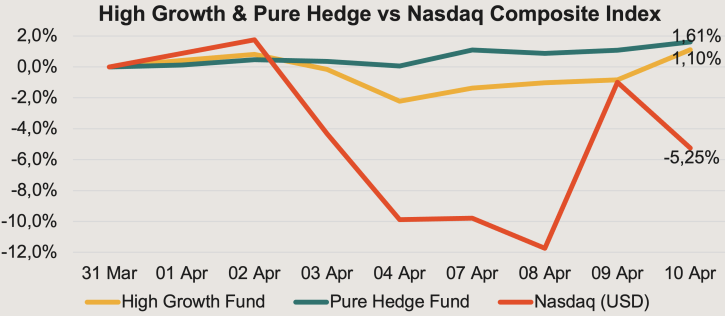
Data as at 10 Apr 2025 | Source: Peregrine Capital, Bloomberg, Morningstar
**inception date is 1 July 1998
Data to 30 June 2025 | Source: Peregrine Capital, Morningstar
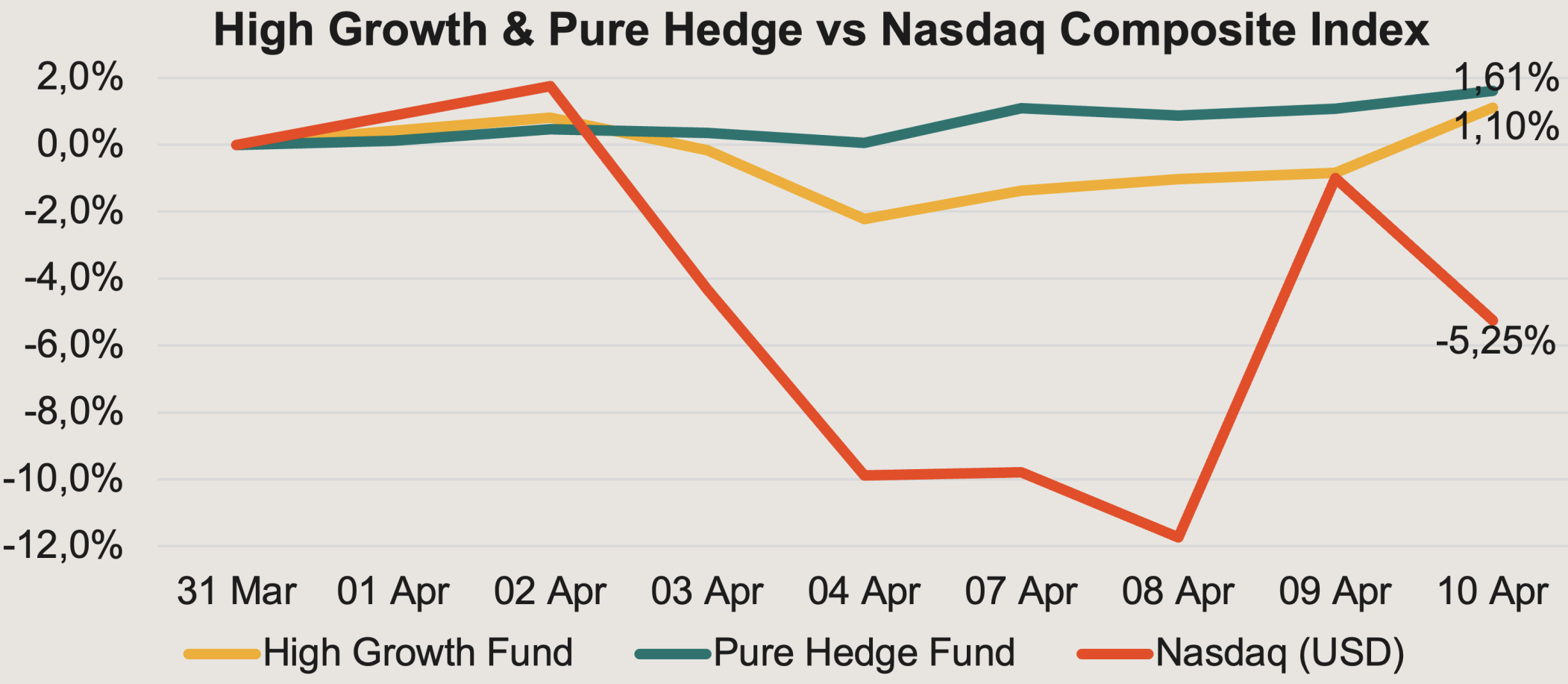
To give you a sense of the panic, the MSCI World Index experienced a peak-to-trough drawdown of 16.3% during the period. The NASDAQ peak-to-trough fall was 22.9%.
Fortunately, the rapid fall in markets and the rise in bond yields sent a clear message to Trump that it would cause complete chaos if these tariffs were implemented at such high levels with such short notice. The panic was only arrested by Trump announcing a 90-day delay before any tariffs above 10% would be implemented.
We continue to view our goal for the funds as two-fold: generating consistent superior returns while also limiting drawdowns or decreasing the downside of volatility for investors. Both funds delivered on this promise during the first half of the year. During the 22.9% fall in the NASDAQ, the peak drawdown for our Pure Hedge Fund was only 1.3% (as measured on a daily basis). Both of our flagship funds ended up nicely in April, when most of this volatility occurred. Limiting drawdowns helps our investors stay confident during periods of market volatility, and this is a key part of our value proposition.
Furthermore, staying invested is integral to compounding your wealth over the long run. We aim to protect your wealth during volatile periods to make a meaningful difference over the long term. We will share some more details about the key tariff week later in the letter.
The High Growth Fund and Pure Hedge Fund delivered net returns of 5.7% and 4.7% respectively, in an extremely volatile global backdrop.
The first half of 2025 was a solid period for the Peregrine Capital funds, with the High Growth Fund and Pure Hedge Fund delivering net returns of 5.7% and 4.7% respectively, in an extremely volatile global backdrop.
After being inaugurated on 20 January, President Trump has consistently been in the news, but his tariffs on imports from other countries have been the “main event” from an investment standpoint and the cause of the market volatility. Based on a largely arbitrary formula, the markets immediately realised that it would lead to immense global disruption if these tariffs were implemented and started pricing that scenario into equities.
Political and Markets Overview
Fixed investment as a % of GDP is insufficient to drive meaningful growth, and unemployment continues to rise.
The most concerning trend that has emerged over the past 12 months is the ANC’s resolve to double down on socialist policies that South Africa simply cannot afford, like the NHI and expropriation of private property without compensation. We need sensible and transparent policies to attract private investment, grow the economy, and create jobs, Mr President. The silver lining is that the electorate is no longer prepared to give the ANC the benefit of the doubt. Polling data following the recent attempt to increase VAT by 2% demonstrated further decline in ANC support, with a commensurate rise in support for the DA and MK. It does appear that democracy is working as intended, albeit slowly.
From an investment standpoint, we are unlikely to see GDP growth exceed 1% for the foreseeable future. South African companies will bumble along for the most part, with exceptional companies outperforming and laggards struggling. The best opportunities are likely to be found where management teams are executing well in their markets, or in “value plays” where earnings multiples are low and dividend yields are high. Growth will remain elusive, but we remain vigilant, seeking companies that can structurally capture market share from their competitors. And as always, we will search for dislocations in company valuations to take advantage of pair trades. This is a continuation of the trend we have observed for the past 8 years under the leadership of the current president. South Africa is likely to remain in a state of flux until the next ANC elections in December 2027.
The “high road” scenario is one where the GNU agrees on a programme of action that is focused on greater private sector participation in the economy, fewer non sensical regulations that stifle investment, clear strides to prosecute the corrupt who hold the economy hostage, and a truly nonaligned foreign policy stance that is designed to serve the interests of the South African economy. We encourage elected officials to look to Argentina for insight into the kind of growth that can be achieved by eliminating unnecessary regulations and unleashing the private sector's potential. For the time being, our base case remains the “bumble along” scenario.
We prefer buying shares during periods of distress. We took advantage of the opportunity presented by the Trump tariff scare to build a position in Taiwan Semiconductor Manufacturing Company Limited (TSMC). TSMC manufactures the leading-edge computer chips more cost-effectively than any competitor. These chips are mainly used to power data centres and smartphones. Their 80-90% market share in leading-edge chips makes them a virtual monopoly, allowing them to earn extremely attractive returns on capital. Our research suggests that this edge, fuelled by economies of scale, control of key technologies and a highly consolidated market structure, is likely to be extremely durable for many years to come. TSMC is arguably one of the most important companies of this era, sitting at the centre of the AI race between the US and China. The selloff presented us with the opportunity to buy TSMC shares at a forward multiple of 15x, which we believe offered high prospective returns.
Post the formation of the Government of National Unity (GNU) in June 2024, South Africa dodged another political bullet. The ANC chose to align itself with the liberal centrist DA, rather than the radical EFF or MK parties. Hope and optimism were in the air once more!
Twelve months into the new administration, the primary “partners” have yet to engage on policy matters to find common ground formally. The ANC refuses to accept that it has lost the elections, and the DA has forgotten that it is no longer on the opposition benches. There appears to be little in the way of trust between the two parties and tensions are escalating in the public domain. The result of this logjam is that economic reforms are slow or non-existent.

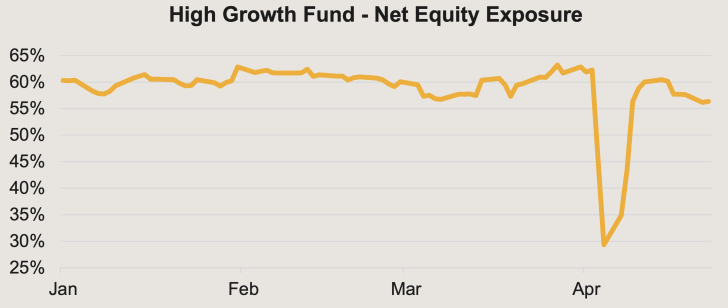
Data to 22 April 2025 | Source: Peregrine Capital
Data to 17 June 2025 | Source: Bloomberg, MS Alpha
We had protected the funds well during the downside and captured a reasonable amount of the upside.
During the aggressive pull-back in April, we added to companies we like, mainly in the US, where the sell-off was most violent. We also sold some of our put options during the pull-back at very attractive levels, locking in some of the gains. It wasn’t clear at all then how the economy would get through this. Trump was firm that there would be no delay and no compromise. However, we felt that after the pull-back, valuations were attractive enough to deploy capital despite the uncertainty ahead.
And then, all of a sudden, sanity prevailed. Trump introduced a 90-day pause, and markets went up like a rocket. The NASDAQ ended up more than 12% on the day, the second-largest up day in history!! We had protected the funds well during the downside and captured a reasonable amount of the upside.
A key part of managing portfolios through these drawdowns is deciding on when to put capital back to work in the market. From our 27 years of experience operating in markets, we have learnt that nobody can call the bottom perfectly. The best one can do is to put capital to work when a lot of bad news is priced into markets, without knowing exactly where the bottom will be.
You will notice how the use of these put options limited the drawdown for both funds in a period where the NASDAQ rapidly fell by more than 10%.
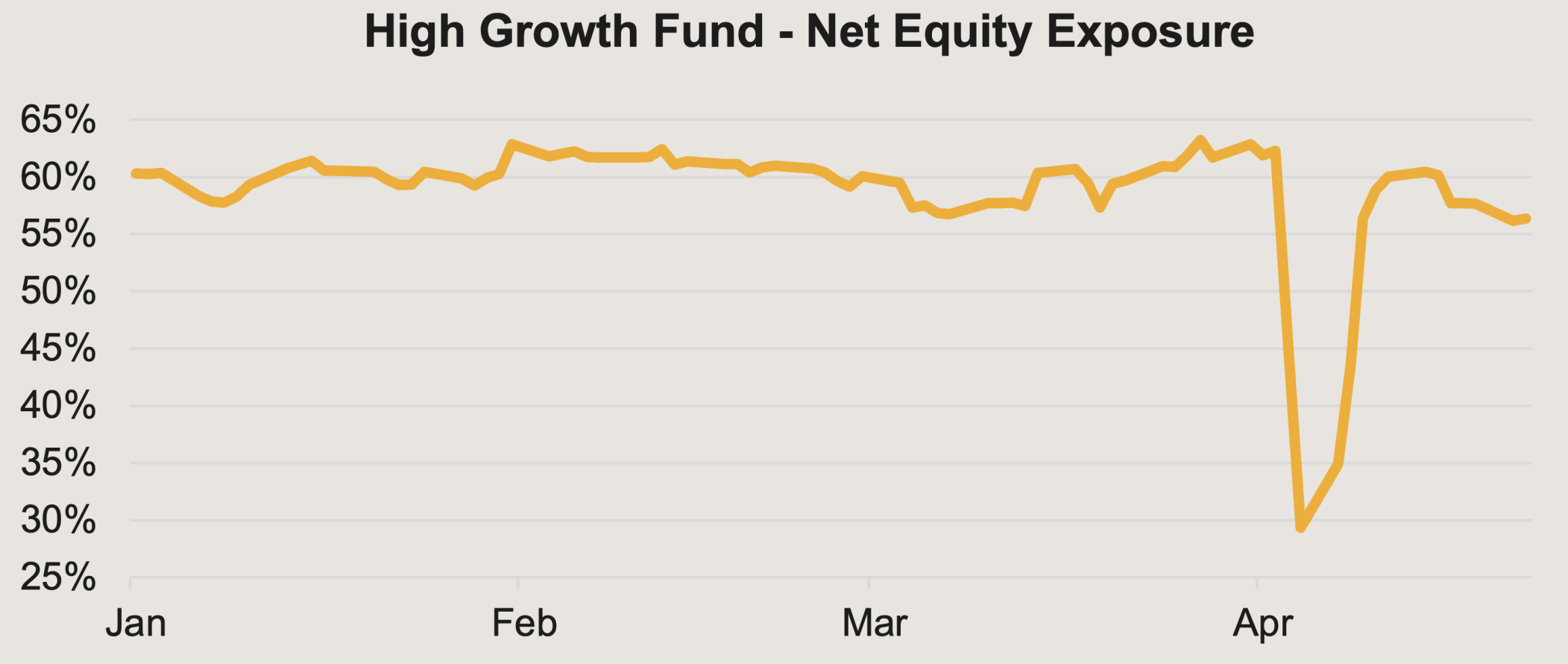
The put options had the impact of rapidly reducing our market exposure during this mini market crash. The insurance policy we bought paid off handsomely.
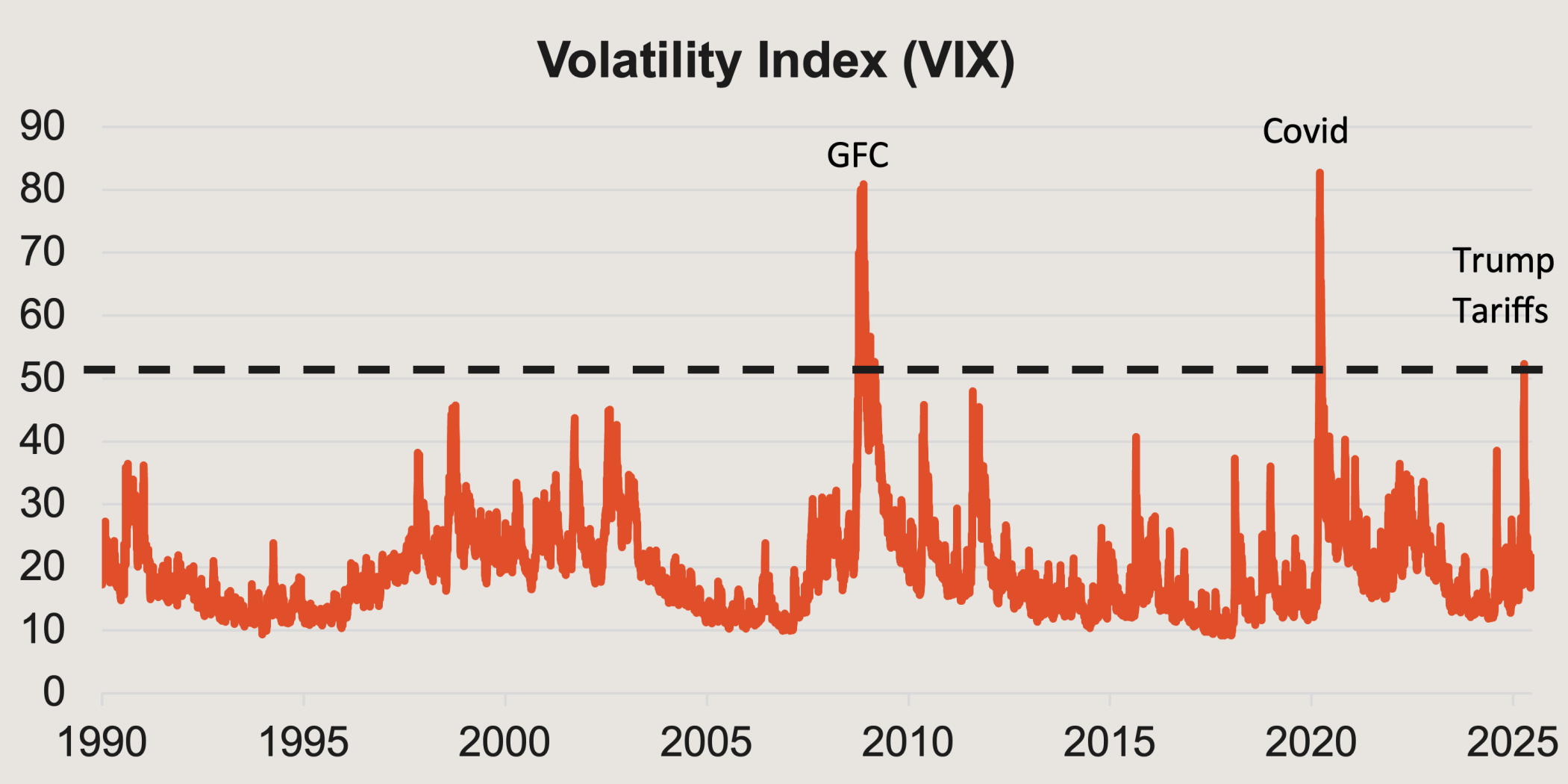
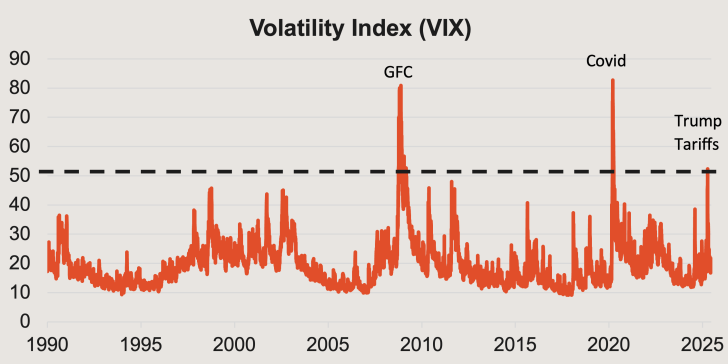
Our instincts proved to be correct on the impact of tariffs on the market. The chart below shows how the volatility of the S&P index spiked after the “liberation day” tariff announcements.
The VIX is widely used as an indicator of market sentiment, and these sorts of spikes in volatility are most often associated with panic and significant market drawdowns.
Globally, we are most excited by the continued progress being made in Artificial Intelligence. New models are being released each month, the efficiency of those models continues to improve, and the capabilities of the technology continue to develop at an extremely rapid pace. We believe that many of the global technology companies we own will continue to be beneficiaries of the improvement in this technology in the years to come. We have previously expressed our confidence in the cost efficiency benefits that will result from the adoption of AI. We are increasingly optimistic that advancements in AI will create significant new revenue opportunities for our companies as well.
The first half of the year was instructive in terms of downside protection. We are permanently on the lookout for events that might lead to a material downside in markets. When we saw the Trump tariff announcement on 2 April, we immediately realised that this spelled trouble.
The whole investment team arrived at the office early on the 3rd to analyse the impact of the tariffs on major economies and markets. During the analysis that morning, we identified a key piece of “intelligence”. The reciprocal tariffs that Trump had proposed were not based on the actual tariffs other countries charged the US, but rather on the trade deficit that existed between the US and other countries, essentially a made-up number that had no rational economic foundation. This realisation, coupled with the fact that Trump had simultaneously imposed these tariffs on every country in the world concurrently, meant that there was no practical way to conclude trade deals with other economies in short order. And finally, the Trump proposals were not grounded in reasonable economic principles, so there was no basis for negotiation.
Based on this conclusion, we became extremely concerned about the potential impact on the global economy and markets if these tariffs were not withdrawn or delayed. The most immediate way to protect the portfolio was to buy short-term put options on the US market, essentially buying an insurance policy to protect the funds if markets go down.
We are increasingly optimistic that advancements in AI will create significant new revenue opportunities for our companies as well.
The best opportunities are likely to be found where management teams are executing well in their markets, or in 'value plays' where earnings multiples are low and dividend yields are high.

Outlook
The US has just passed the “Big Beautiful Bill,” which will reduce taxes and increase government expenditure, leading to a larger budget deficit.
We are currently seeing good value in specific South African opportunities, where companies are executing well and growing their earnings. We also continue to own a portfolio of growing businesses at reasonable valuations globally.
With Thanks

Please contact us via info@peregrine.co.za if you have any questions or comments.

**Fund Name | Inception date | Highest annual return | Lowest annual return | Latest 1 year | Latest 5 years | Latest 15 years |
|---|---|---|---|---|---|---|
Pure Hedge Fund | Jul-1998 | 67.90% (1999) | 1.61% (2008) | 14.53% | 11.38% | 12.43% |
Inflation (CPI) | Jul-1998 | 12.97% (2002) | 0.21% (2008) | 2.81% | 5.19% | 5.02% |
ASISA South Africa MA Low Equity | Jul-1998 | 40.59% (1999) | -10.69% (2008) | 13.34% | 9.66% | 8.31% |
*Fund Name | Inception date | Highest annual return | Lowest annual return | Latest 1 year | Latest 5 years | Latest 15 years |
|---|---|---|---|---|---|---|
High Growth Fund | Feb-00 | 53.01% (2004) | -11.98% (2008) | 19.50% | 15.34% | 17.17% |
FTSE/JSE Capped Swix All Share Index | Feb-00 | 47.25% (2005) | -23.23% (2008) | 24.56% | 16.24% | 11.30% |
ASISA South Africa MA High Equity | Feb-00 | 27.49% (2004) | -8.24% (2008) | 15.15% | 11.93% | 9.39% |
Important Information
Data to 30 June 2025 | Source: Peregrine Capital, Morningstar, Bloomberg.


Investor Letter
Data as at 10 Apr 2025 | Source: Peregrine Capital, Bloomberg, Morningstar
To give you a sense of the panic, the MSCI World Index experienced a peak-to-trough drawdown of 16.3% during the period. The NASDAQ peak-to-trough fall was 22.9%.
Fortunately, the rapid fall in markets and the rise in bond yields sent a clear message to Trump that it would cause complete chaos if these tariffs were implemented at such high levels with such short notice. The panic was only arrested by Trump announcing a 90-day delay before any tariffs above 10% would be implemented.
We continue to view our goal for the funds as two-fold: generating consistent superior returns while also limiting drawdowns or decreasing the downside of volatility for investors. Both funds delivered on this promise during the first half of the year. During the 22.9% fall in the NASDAQ, the peak drawdown for our Pure Hedge Fund was only 1.3% (as measured on a daily basis). Both of our flagship funds ended up nicely in April, when most of this volatility occurred. Limiting drawdowns helps our investors stay confident during periods of market volatility, and this is a key part of our value proposition.
Furthermore, staying invested is integral to compounding your wealth over the long run. We aim to protect your wealth during volatile periods to make a meaningful difference over the long term. We will share some more details about the key tariff week later in the letter.
The High Growth Fund and Pure Hedge Fund delivered net returns of 5.7% and 4.7% respectively, in an extremely volatile global backdrop.
A key part of managing portfolios through these drawdowns is deciding on when to put capital back to work in the market. From our 27 years of experience operating in markets, we have learnt that nobody can call the bottom perfectly. The best one can do is to put capital to work when a lot of bad news is priced into markets, without knowing exactly where the bottom will be.
We had protected the funds well during the downside and captured a reasonable amount of the upside.
Data to 22 April 2025 | Source: Peregrine Capital
Our instincts proved to be correct on the impact of tariffs on the market. The chart below shows how the volatility of the S&P index spiked after the “liberation day” tariff announcements.
The VIX is widely used as an indicator of market sentiment, and these sorts of spikes in volatility are most often associated with panic and significant market drawdowns.
Data to 17 June 2025 | Source: Bloomberg, MS Alpha
The first half of the year was instructive in terms of downside protection. We are permanently on the lookout for events that might lead to a material downside in markets. When we saw the Trump tariff announcement on 2 April, we immediately realised that this spelled trouble.
The whole investment team arrived at the office early on the 3rd to analyse the impact of the tariffs on major economies and markets. During the analysis that morning, we identified a key piece of “intelligence”. The reciprocal tariffs that Trump had proposed were not based on the actual tariffs other countries charged the US, but rather on the trade deficit that existed between the US and other countries, essentially a made-up number that had no rational economic foundation. This realisation, coupled with the fact that Trump had simultaneously imposed these tariffs on every country in the world concurrently, meant that there was no practical way to conclude trade deals with other economies in short order. And finally, the Trump proposals were not grounded in reasonable economic principles, so there was no basis for negotiation.
Based on this conclusion, we became extremely concerned about the potential impact on the global economy and markets if these tariffs were not withdrawn or delayed. The most immediate way to protect the portfolio was to buy short-term put options on the US market, essentially buying an insurance policy to protect the funds if markets go down.
South Africa had become a nation where coalition politics would determine the future trajectory of the country.
The best opportunities are likely to be found where management teams are executing well in their markets, or in 'value plays' where earnings multiples are low and dividend yields are high.
The best opportunities are likely to be found where management teams are executing well in their markets, or in 'value plays' where earnings multiples are low and dividend yields are high.
The best opportunities are likely to be found where management teams are executing well in their markets, or in 'value plays' where earnings multiples are low and dividend yields are high.
Fixed investment as a % of GDP is insufficient to drive meaningful growth, and unemployment continues to rise.
The most concerning trend that has emerged over the past 12 months is the ANC’s resolve to double down on socialist policies that South Africa simply cannot afford, like the NHI and expropriation of private property without compensation. We need sensible and transparent policies to attract private investment, grow the economy, and create jobs, Mr President. The silver lining is that the electorate is no longer prepared to give the ANC the benefit of the doubt. Polling data following the recent attempt to increase VAT by 2% demonstrated further decline in ANC support, with a commensurate rise in support for the DA and MK. It does appear that democracy is working as intended, albeit slowly.
From an investment standpoint, we are unlikely to see GDP growth exceed 1% for the foreseeable future. South African companies will bumble along for the most part, with exceptional companies outperforming and laggards struggling. The best opportunities are likely to be found where management teams are executing well in their markets, or in “value plays” where earnings multiples are low and dividend yields are high. Growth will remain elusive, but we remain vigilant, seeking companies that can structurally capture market share from their competitors. And as always, we will search for dislocations in company valuations to take advantage of pair trades. This is a continuation of the trend we have observed for the past 8 years under the leadership of the current president. South Africa is likely to remain in a state of flux until the next ANC elections in December 2027.
The “high road” scenario is one where the GNU agrees on a programme of action that is focused on greater private sector participation in the economy, fewer non sensical regulations that stifle investment, clear strides to prosecute the corrupt who hold the economy hostage, and a truly nonaligned foreign policy stance that is designed to serve the interests of the South African economy. We encourage elected officials to look to Argentina for insight into the kind of growth that can be achieved by eliminating unnecessary regulations and unleashing the private sector's potential. For the time being, our base case remains the “bumble along” scenario.
Post the formation of the Government of National Unity (GNU) in June 2024, South Africa dodged another political bullet. The ANC chose to align itself with the liberal centrist DA, rather than the radical EFF or MK parties. Hope and optimism were in the air once more!
Twelve months into the new administration, the primary “partners” have yet to engage on policy matters to find common ground formally. The ANC refuses to accept that it has lost the elections, and the DA has forgotten that it is no longer on the opposition benches. There appears to be little in the way of trust between the two parties and tensions are escalating in the public domain. The result of this logjam is that economic reforms are slow or non-existent.
Political and Markets Overview
Globally, we are most excited by the continued progress being made in Artificial Intelligence. New models are being released each month, the efficiency of those models continues to improve, and the capabilities of the technology continue to develop at an extremely rapid pace. We believe that many of the global technology companies we own will continue to be beneficiaries of the improvement in this technology in the years to come. We have previously expressed our confidence in the cost efficiency benefits that will result from the adoption of AI. We are increasingly optimistic that advancements in AI will create significant new revenue opportunities for our companies as well.
We prefer buying shares during periods of distress. We took advantage of the opportunity presented by the Trump tariff scare to build a position in Taiwan Semiconductor Manufacturing Company Limited (TSMC). TSMC manufactures the leading-edge computer chips more cost-effectively than any competitor. These chips are mainly used to power data centres and smartphones. Their 80-90% market share in leading-edge chips makes them a virtual monopoly, allowing them to earn extremely attractive returns on capital. Our research suggests that this edge, fuelled by economies of scale, control of key technologies and a highly consolidated market structure, is likely to be extremely durable for many years to come. TSMC is arguably one of the most important companies of this era, sitting at the centre of the AI race between the US and China. The selloff presented us with the opportunity to buy TSMC shares at a forward multiple of 15x, which we believe offered high prospective returns.
The best opportunities are likely to be found where management teams are executing well in their markets, or in 'value plays' where earnings multiples are low and dividend yields are high.
The put options had the impact of rapidly reducing our market exposure during this mini market crash. The insurance policy we bought paid off handsomely.
You will notice how the use of these put options limited the drawdown for both funds in a period where the NASDAQ rapidly fell by more than 10%.
During the aggressive pull-back in April, we added to companies we like, mainly in the US, where the sell-off was most violent. We also sold some of our put options during the pull-back at very attractive levels, locking in some of the gains. It wasn’t clear at all then how the economy would get through this. Trump was firm that there would be no delay and no compromise. However, we felt that after the pull-back, valuations were attractive enough to deploy capital despite the uncertainty ahead.
And then, all of a sudden, sanity prevailed. Trump introduced a 90-day pause, and markets went up like a rocket. The NASDAQ ended up more than 12% on the day, the second-largest up day in history!! We had protected the funds well during the downside and captured a reasonable amount of the upside.
The first half of 2025 was a solid period for the Peregrine Capital funds, with the High Growth Fund and Pure Hedge Fund delivering net returns of 5.7% and 4.7% respectively, in an extremely volatile global backdrop.
After being inaugurated on 20 January, President Trump has consistently been in the news, but his tariffs on imports from other countries have been the “main event” from an investment standpoint and the cause of the market volatility. Based on a largely arbitrary formula, the markets immediately realised that it would lead to immense global disruption if these tariffs were implemented and started pricing that scenario into equities.
The first half of 2025 was a solid period for the Peregrine Capital funds, with the High Growth Fund and Pure Hedge Fund delivering net returns of 5.7% and 4.7% respectively, in an extremely volatile global backdrop.
After being inaugurated on 20 January, President Trump has consistently been in the news, but his tariffs on imports from other countries have been the “main event” from an investment standpoint and the cause of the market volatility. Based on a largely arbitrary formula, the markets immediately realised that it would lead to immense global disruption if these tariffs were implemented and started pricing that scenario into equities.
The US has just passed the “Big Beautiful Bill,” which will reduce taxes and increase government expenditure, leading to a larger budget deficit.
We are currently seeing good value in specific South African opportunities, where companies are executing well and growing their earnings. We also continue to own a portfolio of growing businesses at reasonable valuations globally.
Outlook

Please contact us via info@peregrine.co.za if you have any questions or comments.
With Thanks

Name | Inception date | Highest annual return | Lowest annual return | Latest 1 year | Latest 5 years | Latest 15 years |
|---|---|---|---|---|---|---|
Pure Hedge Fund | Jul-1998 | 67.90% (1999) | 1.61% (2008) | 14.18% | 10.86% | 11.79% |
Inflation (CPI) | Jul-1998 | 12.97% (2002) | 0.21% (2008) | 6.00% | 4.89% | 5.16% |
ASISA South Africa MA Low Equity | Jul-1998 | 40.59% (1999) | -10.69% (2008) | 14.49% | 7.19% | 7.25% |
*Fund Name | Inception date | Highest annual return | Lowest annual return | Latest 1 year | Latest 5 years | Latest 15 years |
|---|---|---|---|---|---|---|
High Growth Fund | Feb-00 | 53.01% (2004) | -11.98% (2008) | 19.50% | 15.34% | 17.17% |
FTSE/JSE Capped Swix All Share Index | Feb-00 | 47.25% (2005) | -23.23% (2008) | 24.56% | 16.24% | 11.30% |
ASISA South Africa MA High Equity | Feb-00 | 27.49% (2004) | -8.24% (2008) | 15.15% | 11.93% | 9.39% |
Data to 30 June 2025 | Source: Peregrine Capital, Morningstar, Bloomberg.
Important Information